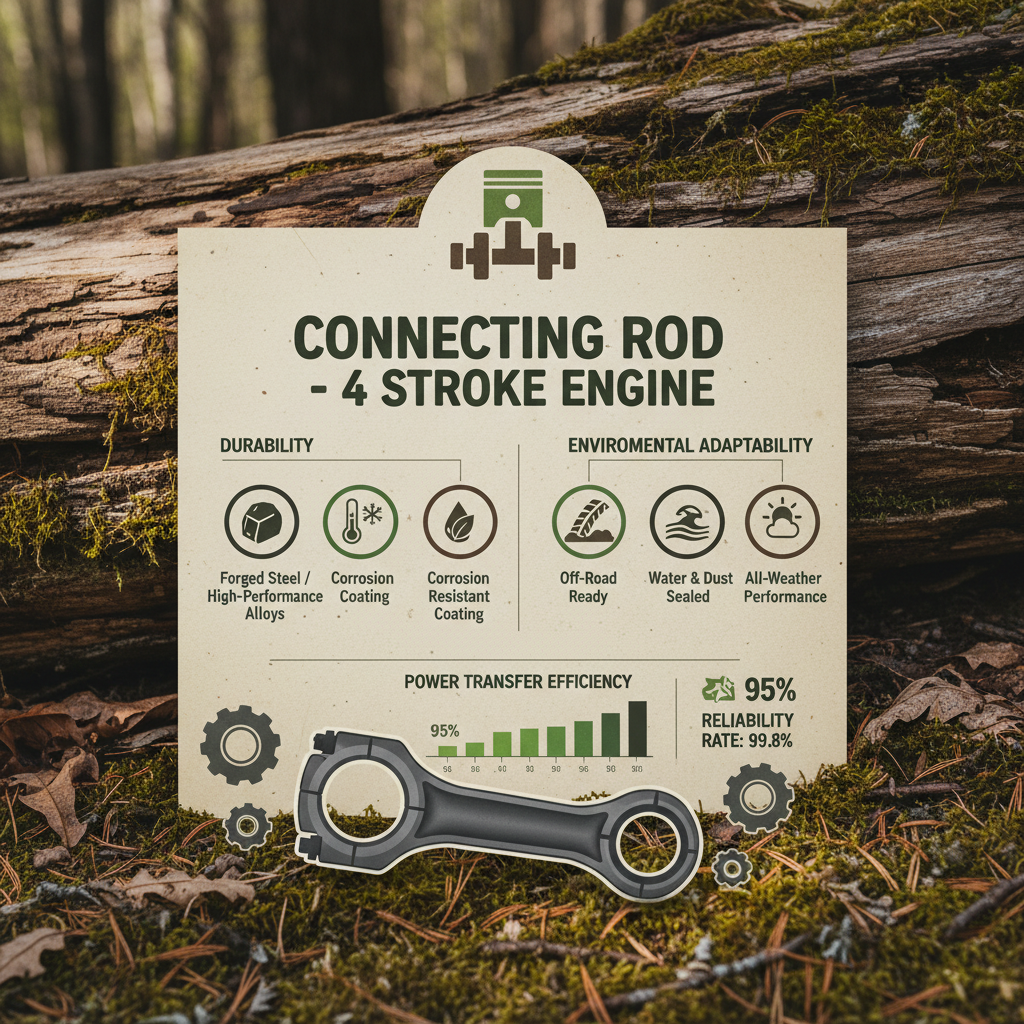
The connecting rod is a critical component within a four-stroke engine, transforming the reciprocating motion of the piston into the rotational motion of the crankshaft. Understanding its design, materials, and function is paramount for engineers, mechanics, and anyone involved in automotive, motorcycle, or small engine maintenance and manufacturing. The global demand for robust and reliable connecting rods is driven by the ever-increasing need for efficient internal combustion engines across a multitude of applications.
This demand isn't limited to automotive. Industries like marine, agriculture, and power generation all rely heavily on four-stroke engines and, consequently, high-quality connecting rods. The economic impact is substantial; the automotive parts sector alone constitutes a multi-billion dollar global industry, with connecting rods representing a significant portion of this market. Furthermore, the increasing focus on engine efficiency and reducing emissions necessitates continuous innovation in connecting rod technology.
Ultimately, a deep understanding of the connecting rod 4 stroke engine enables better engine performance, reduced downtime, and increased overall efficiency, making it a core element of mechanical engineering and essential for numerous global industries.
The Fundamental Role of the Connecting Rod
The connecting rod's primary function within a 4 stroke engine is to transmit force from the piston to the crankshaft, converting the linear (reciprocating) motion of the piston into the rotational motion that ultimately drives the vehicle or machinery. Without a robust and precisely engineered connecting rod, efficient engine operation would be impossible.
This seemingly simple component experiences immense stresses during engine operation. It must withstand high tensile, compressive, and shear forces, as well as bending moments. Therefore, the material selection and design of the connecting rod are critical to ensuring engine reliability and longevity.
Global Relevance and Industry Impact
The connecting rod 4 stroke engine is fundamental to the transportation sector globally. From passenger vehicles and commercial trucks to motorcycles and marine vessels, the vast majority rely on internal combustion engines that utilize connecting rods. The UN estimates over 1.4 billion vehicles are in use worldwide, highlighting the sheer scale of demand.
Beyond transportation, the agricultural sector benefits immensely from engines powered by these components. Tractors, harvesters, and irrigation pumps all depend on reliable connecting rods. Similarly, the construction industry utilizes heavy machinery – excavators, bulldozers, and cranes – all driven by engines incorporating this critical part.
A major challenge facing the industry is the increasing demand for lighter, stronger, and more durable connecting rods to improve fuel efficiency and reduce emissions. This drives ongoing research and development in materials science and manufacturing processes.
Defining the Connecting Rod 4 Stroke Engine
A connecting rod 4 stroke engine refers to the component specifically used within a four-stroke internal combustion engine. The four strokes – intake, compression, combustion, and exhaust – define the operational cycle, and the connecting rod plays a crucial role in each stage by transferring power. It links the piston, which moves up and down within the cylinder, to the crankshaft, which rotates to produce power.
Its connection to modern industry extends beyond simply powering machines. The development and refinement of connecting rod designs are intrinsically linked to advances in materials science, manufacturing techniques (like forging and machining), and engine efficiency. Improvements in connecting rod technology directly translate to reduced fuel consumption, lower emissions, and enhanced engine performance.
The importance of this component reaches humanitarian needs as well. Generators, often powered by four-stroke engines utilizing connecting rods, provide essential electricity in disaster relief operations and remote areas lacking grid infrastructure. Reliable power ensures access to clean water, medical facilities, and communication networks.
Key Factors Influencing Connecting Rod Performance
Several key factors dictate the performance and longevity of a connecting rod 4 stroke engine. Firstly, Material Strength is paramount. Connecting rods are typically forged from steel alloys, aluminum alloys, or titanium alloys, each offering varying degrees of strength, weight, and cost. The material must withstand immense cyclical stresses.
Secondly, Weight Reduction plays a crucial role in enhancing engine responsiveness. Lighter connecting rods reduce reciprocating mass, allowing the engine to rev higher and improve acceleration. However, reducing weight must not compromise strength.
Connecting Rod Performance Metrics
Diverse Applications Across Global Industries
In the automotive industry, the connecting rod 4 stroke engine is integral to both gasoline and diesel engines, powering everything from compact cars to heavy-duty trucks. Manufacturers constantly seek ways to improve connecting rod design to meet increasingly stringent fuel economy and emission standards.
The marine sector relies heavily on robust connecting rods in diesel engines powering cargo ships, tankers, and passenger vessels. These engines require exceptional durability and reliability due to the harsh operating conditions and extended service intervals.
Advantages and Long-Term Value Proposition
Employing high-quality connecting rods yields significant tangible benefits. Reduced engine weight translates to improved fuel efficiency and lower emissions. Enhanced strength and durability minimize downtime and maintenance costs, increasing the overall return on investment.
Furthermore, advancements in connecting rod technology contribute to a more sustainable automotive industry by enabling the development of more efficient and cleaner engines. This positively impacts the environment and promotes responsible resource management.
Future Trends and Technological Advancements
The future of connecting rod 4 stroke engine development is focused on materials innovation. Research into advanced alloys, such as titanium and nickel-based superalloys, promises even lighter and stronger connecting rods. Additive manufacturing (3D printing) is also gaining traction, allowing for the creation of complex geometries and optimized designs.
Digital twin technology, where a virtual replica of the connecting rod is used for simulations and testing, is becoming increasingly prevalent. This allows engineers to identify potential failure points and optimize designs before physical prototypes are even built. The use of advanced coatings to reduce friction and wear is another area of active research.
These advancements are all geared towards improving engine performance, reducing emissions, and extending the lifespan of these critical components.
Overview of Connecting Rod Failure Modes and Mitigation Strategies
| Failure Mode |
Root Cause |
Severity (1-10) |
Mitigation Strategy |
| Fatigue Fracture |
Cyclic Loading |
8 |
Material Selection, Surface Treatment |
| Bearing Failure |
Insufficient Lubrication |
7 |
Improved Lubrication System |
| Plastic Deformation |
Overloading |
6 |
Engine Control Unit Calibration |
| Creep |
High Temperature Exposure |
5 |
Cooling System Optimization |
| Corrosion |
Exposure to Corrosive Environments |
4 |
Protective Coatings |
| Buckling |
Excessive Axial Load |
9 |
Connecting Rod Design Optimization |
FAQS
Common materials include forged steel alloys (like 4340 steel), aluminum alloys (often used in high-performance applications for weight reduction), and titanium alloys (for extreme performance and cost is less of a concern). Each material offers a different balance of strength, weight, and cost. The selection depends heavily on the engine's intended application and performance requirements.
Connecting rods should be inspected during major engine overhauls or whenever unusual engine noises are detected. Specific intervals vary, but a thorough inspection should be conducted every 50,000-100,000 miles (80,000-160,000 kilometers) or as recommended by the engine manufacturer. Look for signs of fatigue, cracking, or bearing wear.
Symptoms of a failing connecting rod bearing include knocking sounds emanating from the engine (often described as a deep, rhythmic thud), reduced oil pressure, and metallic debris in the oil. Ignoring these signs can lead to catastrophic engine failure. Immediate diagnosis and repair are crucial.
Generally, a bent connecting rod is not considered safely repairable. The bending introduces stresses that can lead to catastrophic failure, even after attempted straightening. Replacement is the recommended course of action. Attempting repair often introduces a hidden weakness that leads to immediate or near-future failure.
Balancing is critical for smooth engine operation. Imbalances in the connecting rods (and other reciprocating components) create vibrations and stress on the engine, reducing performance and potentially causing damage. Professional engine builders carefully balance all connecting rods to ensure they have similar weights.
Connecting rod length impacts the engine's geometry and, consequently, its performance. Longer connecting rods generally provide a more favorable rod ratio, leading to reduced side loads on the piston and improved combustion efficiency. However, excessively long rods can increase engine height and weight, potentially causing clearance issues.
Conclusion
The connecting rod 4 stroke engine, though often overlooked, is an indispensable component in a vast array of industries worldwide. Its ability to transform linear motion into rotational power forms the backbone of countless applications, from transportation and agriculture to power generation. Understanding its design, materials, and the factors influencing its performance is crucial for engineers, mechanics, and anyone involved in these sectors.
Looking forward, continuous innovation in materials science and manufacturing technologies will drive further improvements in connecting rod efficiency, durability, and sustainability. Investing in robust, well-engineered connecting rods is not simply a matter of component selection; it's an investment in long-term engine reliability, reduced operating costs, and a more sustainable future. For more information on our range of connecting rods and engine components, visit our website: www.oujiaengine.com